Lenticular clouds form stable air layers over terrain
Meteorologists explain how wind interacting with mountains creates stationary lens-shaped formations at specific altitudes.
By Grace Anderson ·
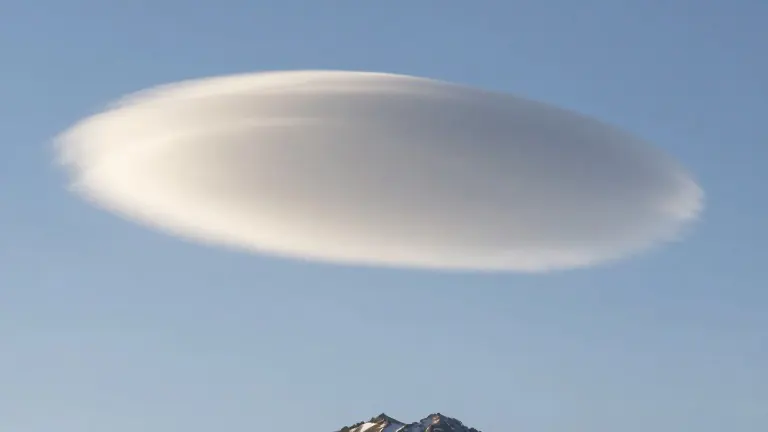
Lenticular clouds form when wind flows over terrain features such as mountains, hills, and buildings. This interaction disrupts airflow and creates turbulent eddies downstream. The phenomenon requires a stable atmosphere to generate gravity waves behind the obstruction.
When air temperature at the crest of these gravity waves drops to the dew point, atmospheric moisture condenses into visible clouds. The stability of the air resists vertical motion, forcing the air to return to its original altitude. As the air sinks into the trough of the wave, any liquid water evaporates back into vapor. This cycle results in clouds that remain perpendicular to the wind direction.
The clouds appear stationary to observers even as wind moves quickly through the area, provided the wind speed remains constant. Lenticular clouds continuously develop and dissipate at the crest and trough of the gravity wave. These wind waves can extend far downstream, with cloud formation occurring specifically at the wave crest.
Meteorologists classify lenticular clouds into three types based on altitude and water phase. Cirrocumulus standing lenticular clouds form above 18,000 feet. They consist mainly of ice crystals and display a delicate, wispy appearance. Altocumulus standing lenticular clouds form between 8,500 and 24,000 feet. They contain a mix of ice and liquid water and often appear fluffy with well-defined lens-like outlines.
Stratocumulus standing lenticular clouds form below 8,500 feet. They consist almost entirely of liquid water droplets. These formations appear thicker and more uniform than their higher-altitude counterparts. The primary differences between the three types are their vertical position and the physical state of the water within them.
The presence of these clouds indicates specific atmospheric conditions. They signal turbulent air and distinct wind patterns. The formation process relies on the precise interaction between wind speed, terrain obstruction, and atmospheric stability.