Sheffield researchers reverse engineer Roman color-shifting glass
A team used a fragment of the Lycurgus Cup to recreate a 1,600-year-old dichroic material, culminating in a new sculpture opening at the Millennium Gallery on November 6.
By Grace Anderson ·
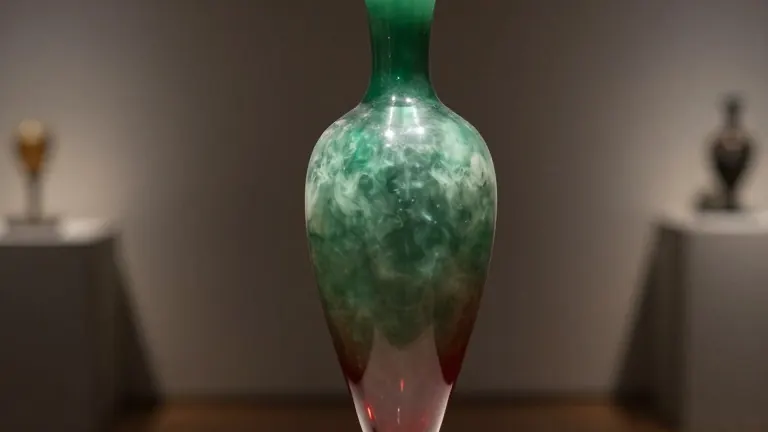
Researchers at the University of Sheffield announced last week that they have successfully recreated the dichroic glass used to create the Lycurgus Cup, a 1,600-year-old artifact currently housed in the British Museum. The cup, dating to the 4th century CE, is one of only 40 surviving glass cage cups from that era and remains one of the most complete examples. In 2022, an international panel of artists and conservators named the piece one of the seven glass wonders of the world.
The material exhibits a distinct optical property: it appears jade green in reflected light but shifts to ruby red when light is transmitted through it. This effect is caused by the presence of tiny gold and silver nanoparticles embedded within the glass structure. Dr. Lisa Hollands, a technician at the university’s school of chemical, materials and biological engineering, led the effort to replicate this specific chemical composition.
Hollands, who has worked with glass for over 25 years, collaborated with Professor Caroline Jackson, a leading expert in Roman glass. The team analyzed a fragment of the original artifact to derive a recipe. They aimed to mimic the materials the Romans likely used, though Hollands noted that the process required adapting ancient knowledge with modern scientific understanding to achieve the correct form of the metallic particles.
The project was initiated for the University of Sheffield’s 2025 LightFest, a festival organized by the Molecular Photonic Breadboards project in partnership with the University of Bristol. The initiative is funded by the Engineering and Physical Sciences Research Council. Christina Metcalfe, the project manager for Molecular Photonic Breadboards, tasked the team with recreating the glass to provide a tangible demonstration of how nanoparticles affect light transmission and reflection.
Hollands spent time experimenting with different furnace types, raw materials, and oxygen levels to stabilize the color-changing effect. She described the challenge of introducing precise amounts of gold and silver into the molten glass as the most difficult aspect of the work. The final product was displayed at LightFest, where it served as the foundation for a contemporary art commission.
Glass artist Elliot Walker, a winner of the second season of Netflix’s Blown Away, was commissioned to create a sculpture using Hollands’ new recipe. Walker sought to maintain a classical form while highlighting the dichroic properties of the material. He blended the narrative of the Lycurgus Cup with the structure of the Farnese Atlas sculpture, replacing the globe traditionally held by the figure with a cup made from the new glass.
The sculpture is scheduled for public display at the Millennium Gallery in Sheffield from November 6 to November 15. After that period, the piece will move to the Turner Museum of Glass at the University of Sheffield. Metcalfe stated that the project aimed to help the public understand the visual impact of embedded nanoparticles. The team reported that the final result exceeded their initial expectations for the project.
The Lycurgus Cup itself remains in the British Museum, where it continues to serve as a primary reference for scholars studying ancient glassmaking techniques. The Sheffield team’s recreation stands as the first modern reproduction of the cup’s specific dichroic glass recipe, derived directly from physical analysis of the original artifact.