North Korea's Warhead Count Climbs From 20 to 60 Since 2018 Summit
Washington's push for a fresh Trump-Kim meeting at the upcoming APEC gathering in China has stalled as Pyongyang turns its attention to Moscow and Beijing.
By William Turner ·
Talks of a fresh Trump-Kim summit have stalled, but North Korea's nuclear stockpile has not. The number of warheads in Pyongyang's possession has grown from an estimated 10 to 20 at the time of the 2018 summit to roughly 60 today, according to the Stockholm International Peace Research Institute. Prospects for a meeting between President Donald Trump and Kim Jong Un at the Asia-Pacific Economic Cooperation gathering in China, scheduled for weeks from now, have dimmed, according to four people familiar with discussions among U.S., North Korean, Chinese and South Korean officials.
In August, Trump said he expected to meet Kim this year. He later told reporters at the White House that he "may" see Kim, adding, "That'll be exciting, won't it?" A week later he said, "I don't know .. I'm not sure that anybody's asking for a meeting." A White House spokesperson said in a statement, "We have nothing to share regarding a summit between the President Trump and DPRK leader Kim Jong-Un."
The timeline of the split runs through Pyongyang's recent diplomatic calendar. Kim joined Xi Jinping and Vladimir Putin at a military parade in Beijing last September, then hosted leaders from Vietnam, Laos and Belarus in Pyongyang in the months after. Xi visited North Korea in June, his first trip in seven years. Kim arrived at the Chinese border last weekend for a meeting with one of Xi's top lieutenants. A Chinese official said meetings of that kind typically take months to arrange and a last-minute effort to secure an encounter is "unlikely."
An Asian diplomat said Pyongyang had not explicitly rejected an invitation but had offered no substantive response about a potential meeting. A former U.S. official and another person familiar with the discussions said North Korean officials have shown little sincere interest in the White House's outreach. The people familiar with the discussions spoke on the condition of anonymity because of the sensitivity of the diplomatic exchanges.
On Thursday, cryptocurrency exchange Binance confirmed a $6.3 billion hack, reportedly the largest in cryptocurrency history, which blockchain intelligence firms have attributed to North Korean hackers. North Korea's GDP grew by more than 3 percent annually since 2023, according to South Korean central bank estimates. Russia's war in Ukraine has also supplied Pyongyang with hard currency and military technology in exchange for ammunition and roughly 12,000 troops.
Patricia Kim, senior fellow at the Brookings Institution, said Washington was negotiating from a position of considerably greater leverage when Trump first engaged Kim in 2018. "Today, Kim is in a much stronger position," she said, citing a security partnership with Moscow and deeper economic and political ties with Beijing. Sydney Seiler, a former U.S. intelligence officer on North Korea now at the Center for Strategic and International Studies, said, "As far as what North Korea might tangibly want out of improved relations, economic trade and politically, they don't need the United States."
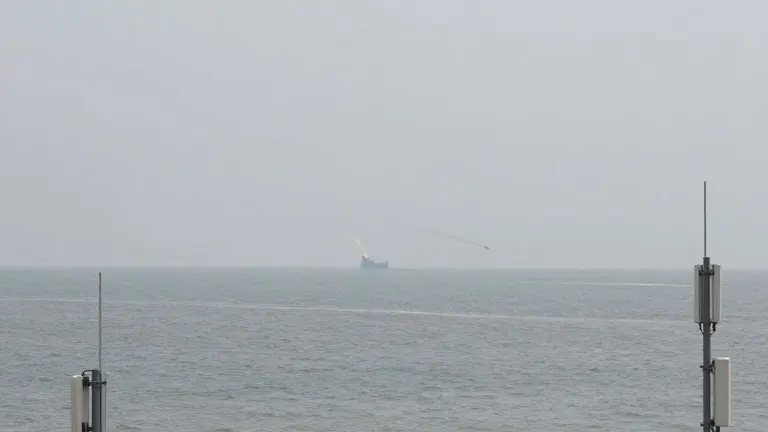
Tensions with South Korea have risen alongside the diplomatic silence. On Thursday, North Korea fired a barrage of ballistic missiles into waters off its east coast, escalating a dispute over a border mine explosion that injured three South Korean soldiers last month. Pyongyang also tested an intermediate-range ballistic missile earlier this month. At a trilateral meeting last month, Secretary of State Marco Rubio, alongside his Japanese and South Korean counterparts, reaffirmed the U.S. commitment to North Korea's complete denuclearization.
North Korea has developed more sophisticated weapons since the 2018 summit, including a solid-fuel intercontinental ballistic missile first tested in 2023 that could reach anywhere in the continental United States. In a March speech to North Korea's Supreme People's Assembly, Kim denounced U.S. military aggression and rejected demands for denuclearization. The North Korean mission to the United Nations in New York did not respond to a request for comment.