Trump's Michigan speech and Vatican vote frame final week of midterms
A presidential rally remark in a swing state and the first-ever papal mail ballot are driving religious discourse in the 2026 election cycle.
By William Turner ·
Religious identity has emerged as a central friction point in the 2026 midterm elections, with candidates and clergy navigating contested ground in key battleground states. In Michigan, the U.S. Senate race between Democrat Abdul El-Sayed and Republican Mike Rogers has been defined by sharp rhetoric regarding Islam. At a recent campaign rally, President Donald Trump described his support for the Republican candidate as a defense against a specific religious threat. He stated, "I'm here to keep a jihadist Muslim Brotherhood member from becoming a United States Senator." El-Sayed, who is Muslim, maintains that he has no affiliation with the Muslim Brotherhood, a group he has denied ties to since winning the Democratic nomination earlier this year.
The presidential comment has intensified a debate that has simmered since the summer. Imam Dawud Walid, executive director of the Michigan chapter of the Council on American-Islamic Relations, described the current political climate as distinct in his 21 years with the organization. "I have never seen this level of racism and anti-Muslim animus in our political discourse," Walid said. He argues that labeling a candidate a "jihadist" dehumanizes the roughly one million Muslims in the state and makes them feel afraid, though he remains hopeful that voters will prioritize policy over prejudice.
Meanwhile, a separate controversy involving the Catholic Church has drawn attention to the White House's use of religious imagery. The administration recently released video and photographs of Catholic bishops praying with President Trump in the Oval Office. Several participating bishops have since clarified that their attendance was not an endorsement of the president or his policies. Milwaukee Archbishop Jeffrey Grob issued a public apology for the discomfort the images caused, claiming the White House manipulated the event. James Wall, bishop of Gallup, New Mexico, stated that the group was present to discuss immigration and expressed dissatisfaction with how the footage was utilized.
Not all Catholics are convinced by the bishops' explanations. Natalia Imperatori-Lee, a theology professor at Fordham University, expressed skepticism about the claim that senior clergy were politically naive. "You don't get to be a bishop in the Catholic Church by being politically naive or politically ignorant," she said. She noted that while clergy often pray for political leaders, the timing of the photo op so close to Election Day makes the perception of the event difficult to manage.
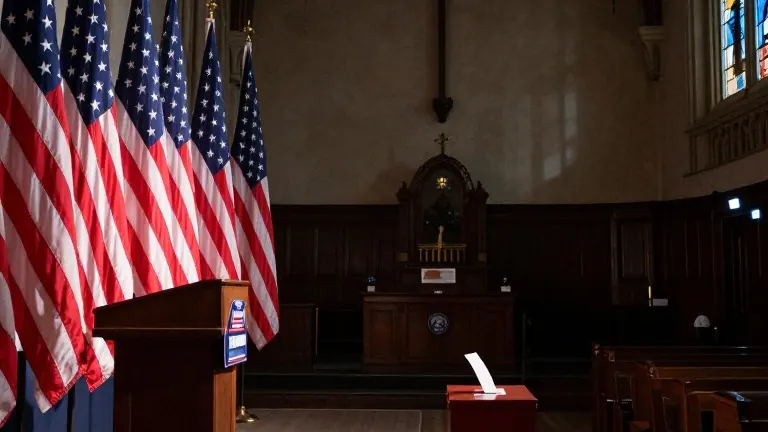
Data suggests the religious photo op may have had the opposite of its intended effect. A recent Pew Research poll indicates that Catholic support for President Trump has declined by 20 points since his inauguration last year. In a related development, the Vatican confirmed that Pope Leo XIV cast a vote by mail, making him the first pope to participate in an American general election.
These developments occur as the Senate race in Michigan remains a toss-up, meaning the outcome of that single state could determine control of the upper chamber. With the election days away, both parties are leveraging these religious flashpoints to energize their bases, while religious leaders attempt to distance themselves from the political implications of their public appearances.