Montevideo's Borro Neighborhood: Pope Leo XIV to Visit Amid Drug Violence and Poverty
Residents of a dirt-road community in Uruguay brace for the pontiff's arrival, where parish programs combat crime and provide shelter from gunfire.
By Jonathan Reed ·
Lucía Pintos, a 21-year-old student, prepares to teach in the Borro neighborhood of Montevideo, Uruguay. The community, located in the Casavalle municipality, is preparing to host Pope Leo XIV. Pintos describes the area as a fragile refuge for residents living with the daily threat of narcotics violence. She notes that children often attend school primarily to receive meals, and parents hesitate to let them play outside due to frequent gunfire.
The Borro is the first stop on the pope's tour of Uruguay, Argentina, and Peru. He will visit the works of the Our Lady of Guadalupe Parish. The parish builds homes, promotes local employment, and supports addicts in recovery. Pintos, who became a Catholic after the death of her godfather, serves as a youth leader and studies with an ecclesial scholarship. She aims to show her faith through actions rather than words when speaking to her non-believing friends.
Daniel Sturla, the Archbishop of Montevideo, stated that no other place in Uruguay has a stronger Catholic Church presence than the Borro. Father Pablo Coimbra leads the parish mission. One day after receiving the Vatican advance team, Coimbra walked through the neighborhood with reporters. He explained that families know when to stay indoors because of shooting incidents. Residents often drop to the floor during machine-gun bursts because stray bullets can hit anyone.
In October 2025, Interior Minister Carlos Negro described Uruguay's homicide rates as epidemic. He said reducing the numbers was urgent and possible. President Yamandú Orsi has identified insecurity in these sectors as his main concern. Official counts show 98 homicides in Montevideo through September, a 13.5% increase from the same period last year. More than 46% of these killings occurred in Casavalle, the Borro, and nearby areas.
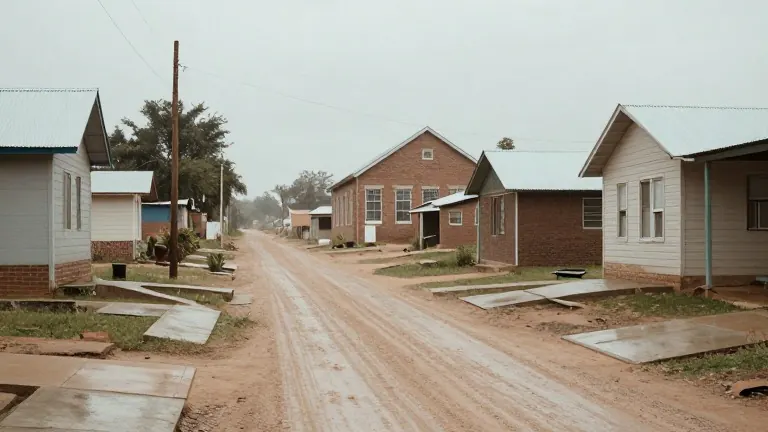
The neighborhood features poor housing and dirt roads that descend toward a creek. Mud frequently enters homes, particularly for those living at the bottom near the water. Coimbra summarized the situation by saying residents lower down receive all the runoff from above. A concrete path built by neighbors now cuts through the landscape to prepare for the papal visit. The path leads to a restored soccer field where young player Lautaro Martínez trains, though practice is currently paused due to recent shootings.
Coimbra stated that the Church's presence creates a difference between drug consumption and abstinence, as well as between continuing education and dropping out. Neighbors sometimes bring injured people to the parish because ambulances only enter up to the temple. The priest recalled that drug gangs previously forced families out with gunfire to set up stash houses, leaving the parish as a place of refuge. To fight crime, the parish leads social housing projects where neighbors build more than 100 units with sanitation systems, creating local jobs.
In a country rarely associated with organized crime, neighborhoods like the Borro, Casavalle, Marconi, Cerro Norte, and La Teja live with the noise of weapons during territorial disputes over micro-trafficking. These disputes often recruit teenagers as guards. The government has deployed armored vehicles, originally donated by the United States for UN peace missions, to patrol these areas. Many young people seeking to leave criminal lives find support in faith.
The parish holds a Mass on Mondays for people experiencing homelessness, drawing dozens from across the city. Coimbra noted that visitors come for a shower, two meals, and to be listened to. During communion, most attendees cross their arms over their chests, a sign that they are not baptized. Church data indicates that in 2025, only 2,200 of 30,000 newborns in Uruguay received the sacrament.
Pablo Acosta, 28, was born in the neighborhood and knows the dynamics of crime. He lives between shelters and the street, works informally in local markets, and sends money to his 10-year-old son, whom he does not see due to his addictions. Acosta has a gunshot wound in his stomach and knife marks from debts and theft. He has been trying to quit drugs for a month. In this environment, Pintos hopes to offer children a better future, noting that while violence and malice exist, there is also immense love.
Coimbra explained that residents lack clubs, English classes, rugby teams, or even consistent access to soccer. This idle time creates space for intervention. He described reaching out to those who have walked dark paths as a task for the Church.