
Israel faces political impasse as Netanyahu and Eisenkot blocs miss majority
With 70% of votes counted, both major Jewish coalitions are short of 61 seats, forcing opposition leaders to decide whether to ally with Palestinian parties or trigger new elections.
By Jonathan Reed ·
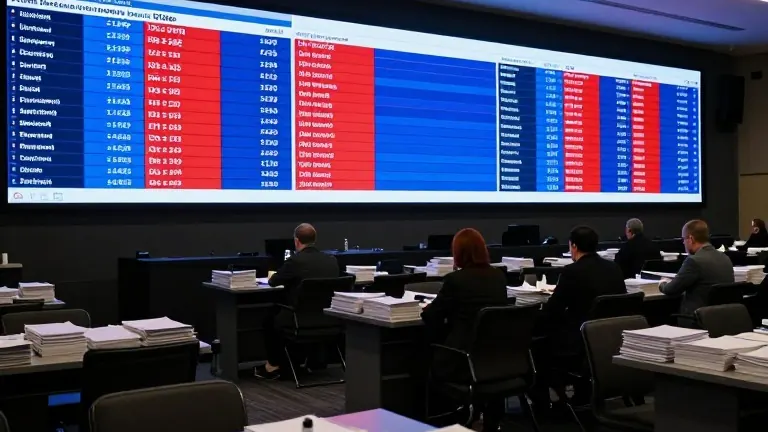
Israel’s government hangs in the balance as Benjamin Netanyahu loses his governing majority, leaving his political fate in the hands of opposition Jewish parties who must decide whether to join forces with Palestinian groups.
Gadi Eisenkot, leader of the Jewish opposition bloc, declared victory overnight for what he termed a “Zionist majority.” He appeared to rule out a broad coalition with Palestinian parties. However, as vote counting progressed on Wednesday, initial exit poll projections of a narrow Eisenkot lead looked increasingly unlikely.
The prime minister’s bloc edged ahead as the count moved forward. Absentee ballots from deployed soldiers and other voters have not yet been tallied. With 70% of votes counted, both Jewish blocs appear certain to fall short of the 61 Knesset seats required for a majority.
Eisenkot and his allies now face a stark choice: form a pact with Arab Israeli parties heading for a record 16 to 19 seats, or hand Netanyahu a lifeline through new elections or a unity government. Donald Trump claimed his overt backing made a difference for the prime minister. “When the endorsement went out, it helped him a lot,” Trump said.
Yair Golan, leader of the centre-left Democrats in Eisenkot’s Change bloc, urged negotiations with the Joint List and Ra’am. “We have no future here if we don’t stop being afraid,” Golan wrote on X. He argued that refusing Arab votes amounts to surrendering to Netanyahu.
Yousef Jabareen, leader of the Joint List, stated his party’s strong performance means it “can’t be ignored under any political scenario.” Jabareen said the current government, particularly under national security minister Itamar Ben-Gvir, “has made life bitter for every Arab citizen.” His party aims to oust the government of Netanyahu, Ben-Gvir, and Smotrich.
Counting all votes may take a few more days, with soldier ballots last. The army vote usually swings right, though older moderate reservists on active duty may complicate that trend. President Isaac Herzog will grant one party leader six weeks to form a government. If that fails, the chance passes to the rival leader.
Netanyahu will remain in a caretaker role until a new majority forms. Tuesday’s election drew 77.7% turnout, the highest since 1999. It occurred as Israel faces genocide accusations in Gaza and ethnic cleansing charges in the West Bank. Netanyahu, Israel’s longest-serving prime minister, is wanted by the International Criminal Court for alleged war crimes.
Source: The Guardian